
As part of Hydrogen Week 2026, we discussed the practical implementation of RFNBO certification, the GHG quota and hydrogen marketing with more than 40 participants. We would like to thank everyone for the strong interest, the high level of participation and the open technical exchange.
The webinar made clear that the economic viability of hydrogen projects depends not only on electricity costs and technology, but to a large extent also on a regulatorily sound design. Three points were particularly in focus:
1. Optimising RFNBO production economically
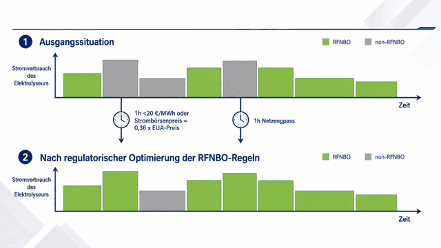
A central topic was the question of how to maximise RFNBO production without incurring unnecessary costs through oversized PPA procurement. The key here is the regulatorily sound use of the existing scope, for example through intelligent operation and a suitable balancing logic.
2. Calculating GHG quota revenues realistically and completely
For many projects, the GHG quota is a significant economic building block. In the webinar, we showed what matters for a robust revenue estimate and how different assumptions affect economic viability. For an initial assessment, a free revenue calculator is also available on our website.
3. Mapping trailer logistics correctly in mass balancing
The distribution of hydrogen by trailer is also demanding from a regulatory perspective. So that certification, proof management and marketing later interlock reliably, the delivery and volume logic must be set up in a mass-balance-compliant way from the outset. This practical feasibility was another focus of the webinar.
Our sincere thanks also go to our guest speakers from TÜV SÜD, WUN H2 and Rießner Gase for their valuable practical contributions and well-founded technical insights.
The presentations from the webinar are available for download here:
The webinar review shows once again: economically viable hydrogen projects require not only technical concepts, but also a robust regulatory implementation along the entire process chain.